
When I was a child, I spent a lot of time at my friend Philippa’s place. Her apartment had a lodger, an artist who was editing a short film on a cutting table. Completely analog, we’re talking 1979, 1980. On his shelves he kept the full run of the legendary Tim & Struppi comics (Tintin et Milou in the original) and every Asterix & Obelix album published so far. We were welcome to borrow any of them at any time, and I was absolutely obsessed with Tintin, even though I couldn’t yet read a single word.
It was the visual world that got me. The clarity of the lines. The way Hergé could build an entire universe out of something so precise and uncluttered. I genuinely believe those early hours spent staring at those pages didn’t just lay the foundation for my degree in graphic design, they’re still at work in my collage practice today.
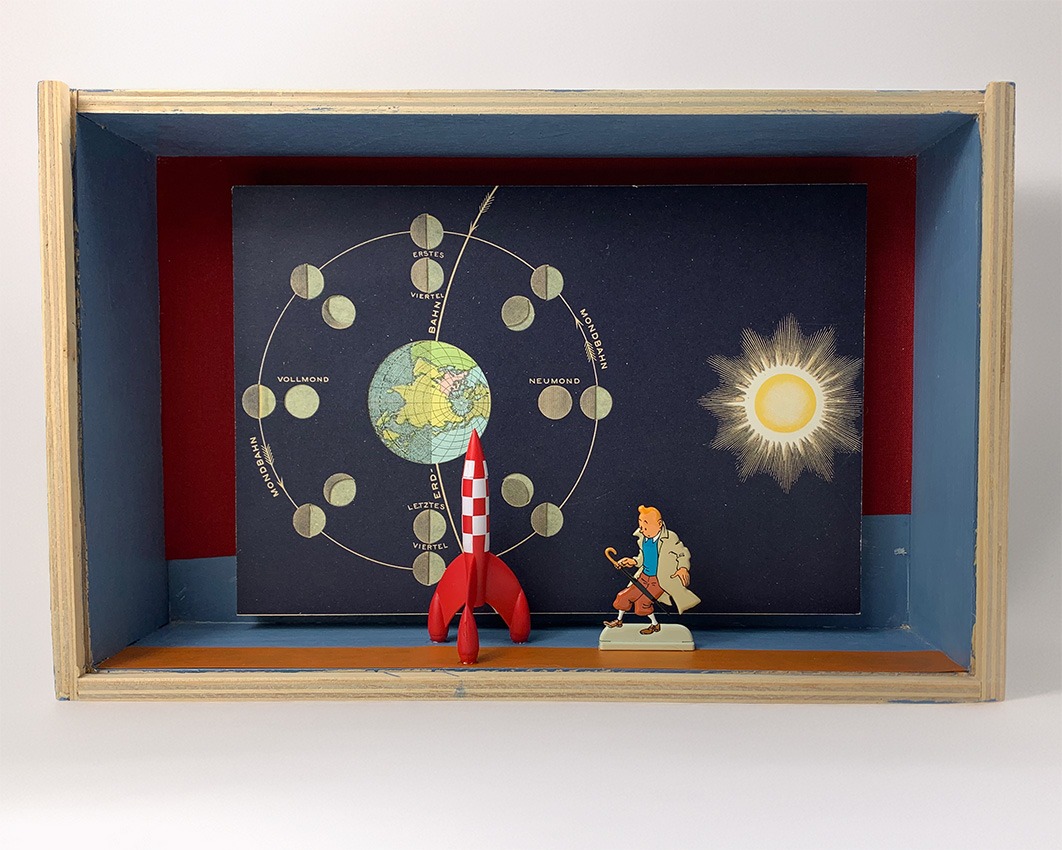
For this piece, I made a small diorama inside a wooden box. The backdrop is a vintage astronomical chart showing the moon’s orbit around the earth, the phases arranged in a ring around a beautifully illustrated globe, with a radiating sun to the right. In front stand two figurines: the iconic red-and-white checkered rocket from Destination Moon, and Tintin himself, umbrella in hand, his feet stuck to the ground — a nod to The Shooting Star, in which the heat is so intense that the asphalt begins to melt.
Needless to say, I have of course visited the Musée Hergé in Louvain-la-Neuve. Some things are non-negotiable.